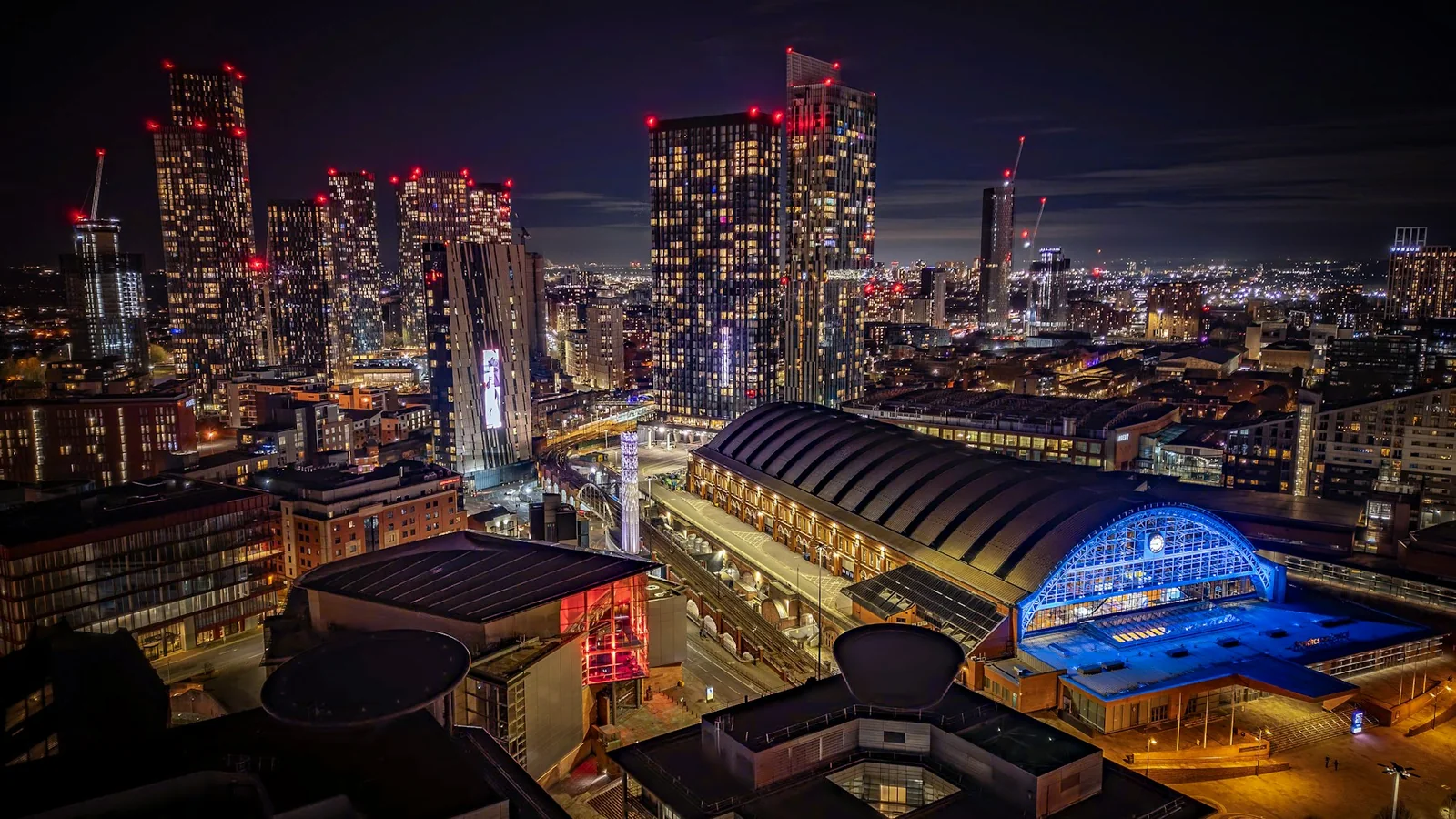
The UK’s fastest-growing city economy, one of its strongest rental markets, and a multi-billion-pound pipeline of regeneration. Here is the full investment case.
Named the UK’s fastest-growing city economy in 2025 (EY ITEM Club), Manchester pairs strong rental yields with genuine, funded growth. Its city-centre population has gone from near-empty in the 1990s to around 100,000 today — and is projected to reach roughly 250,000 by 2035.
Manchester city centreManchester isn’t promising future investment — it’s delivering it. These are the landmark regeneration and infrastructure schemes reshaping the city and the districts around it.
15,000 new homes for 40,000+ residents across 15–20 years, plus a 46-hectare City River Park. Designated one of the government’s new-town projects.
Live30 acres beside Piccadilly station — 1,500 homes, 1.6m sq ft of commercial space and Mayfield Park, the first new city-centre park in a century.
Under constructionAviva Studios — the UK’s biggest cultural investment since Tate Modern — opened in 2023, anchoring a new residential and enterprise district.
Open & building outA decade-long upgrade of Manchester Airport enabling around 8 million extra passengers a year through an expanded Terminal 2.
In deliveryA 20-acre Co-op-anchored mixed-use neighbourhood — one of the largest developments in the North West.
OngoingA full hospital rebuild anchoring wider regeneration and thousands of jobs in the north of the city.
CommittedJLL forecasts Manchester among the UK’s strongest performers for house-price growth over the coming years — on top of a rental market that has already surged. Combine capital growth with a ~6.6% yield and the total-return case is compelling.
One of Europe’s largest student populations anchors demand in and around the centre, alongside a fast-growing young-professional and build-to-rent core, with more family demand in suburbs like Levenshulme.
Every area here sits inside the M1–M4 city-centre postcodes — no outer suburbs, no commuter towns.
Manchester’s tallest residential cluster — Deansgate Square and Beetham Tower — directly on the Metrolink and mainline station, drawing young-professional and corporate tenants.
Manchester’s legal and financial quarter — PwC, Deloitte and HSBC anchor daytime demand for newer, higher-spec residential stock right next to Deansgate.
A former mill district turned one of the city’s most sought-after postcodes — Cutting Room Square and Kampus draw strong lifestyle-driven demand from creative and professional tenants.
Manchester’s creative and nightlife district — independent retail, bars and converted warehouses draw a deep young-professional rental pool, walking distance to Piccadilly.
A single-owner, £1bn+ regeneration of the area north of Victoria station led by the Co-operative Group and Hines — office-led, with residential now following as an early-stage growth story.
The arrival point for HS2 and Northern Powerhouse Rail’s Manchester upgrade and the Metrolink hub — a transport-led investment case rather than a purely lifestyle one.
A vast, renewing pool of students and graduates is the engine of Manchester’s rental demand — and increasingly, they stay.
The University of Manchester is a Russell Group research powerhouse — where the atom was first split and graphene isolated — with particular strength in advanced materials, computing and AI, and life sciences. That research base feeds a young, highly-skilled workforce straight into the city’s employers.
Manchester runs the UK’s largest light-rail network — Metrolink’s 8 lines and 99 stops — feeding a city centre that’s within easy reach of every major English city. Manchester Airport is the third-busiest in the UK, handling 32.1 million passengers in 2025 across 200-plus destinations.
3rd-busiest UK airportGreater Manchester generates over £90bn of economic output and was named the UK’s fastest-growing city economy in 2025. Spinningfields — the “Canary Wharf of the North” — anchors a financial and professional-services core that has pulled major employers north.
Major employers with a significant Manchester presence include:
“Fastest-growing city economy, ~6.6% yields, a city-centre population set to more than double, and billions already in the ground. Manchester is where growth and income actually meet.”
Book a call and we’ll bring you current, fully-vetted Manchester opportunities — with the real, cost-in numbers behind every one.
*Figures are drawn from public sources including ONS, HESA, EY and JLL. Forecasts (e.g. JLL house-price growth) are third-party projections, not guarantees; property values and rents can fall as well as rise. Yields and prices vary by property, area and market conditions. This is general information, not financial advice.
Yes, on the numbers — average yields around 6.6%, forecast five-year growth of 19.3%, and the UK's fastest-growing city economy. It's a genuine income-plus-growth market rather than a pure yield play like some Northern cities, which is why it suits investors who want both.
Around 6.6% gross on average, though this varies materially by postcode and property type — HMO strategies typically push higher, prime city-centre apartments lower. Model your own figures net of costs on our yield calculator rather than relying on a headline number.
The active regeneration zones — Victoria North (Homes England-backed, £4bn across seven neighbourhoods), Mayfield (the new city-centre park and district) and NOMA — are where the infrastructure spend and delivery activity is concentrated right now.
Some generic, poorly-located stock has struggled with intense competition after a decade of heavy building — which is exactly why we don't source on postcode alone. Location within the city, construction quality and the operator behind the building matter more than ever, and it's the first thing our due diligence process checks.
No — a large share of our Manchester investors buy remotely from overseas. See our guide for overseas investors for exactly how that works.
Manchester combines one of Europe’s largest student populations with fast-growing professional and build-to-rent demand in the centre, which is why average rents have kept climbing even after a stronger multi-year run in new-build apartments specifically (JLL research recorded new-build apartment rents up around 50% between H1 2021 and H1 2024 in Manchester & Salford). The city-wide gross yield of 6.6% (Zoopla) reflects that sustained demand against still-moderate average prices.
Non-UK residents pay a 2% Stamp Duty Land Tax surcharge on top of all other applicable rates, which stacks with the standard 5-percentage-point surcharge on additional/buy-to-let properties — so a non-resident buying a second property here pays 7 percentage points above the standard residential rate (GOV.UK; Deloitte TaxScape, current 2025/26 rates). We’ll model the exact figure for any specific property before you commit, and our stamp duty calculator gives you a fast estimate.
One email a month: a shortlist of current, fully-underwritten UK opportunities with real net figures — plus a short read on where the market is moving. No spam, no hard sell, unsubscribe in one click.